Proof: 30 days on one real Tesla
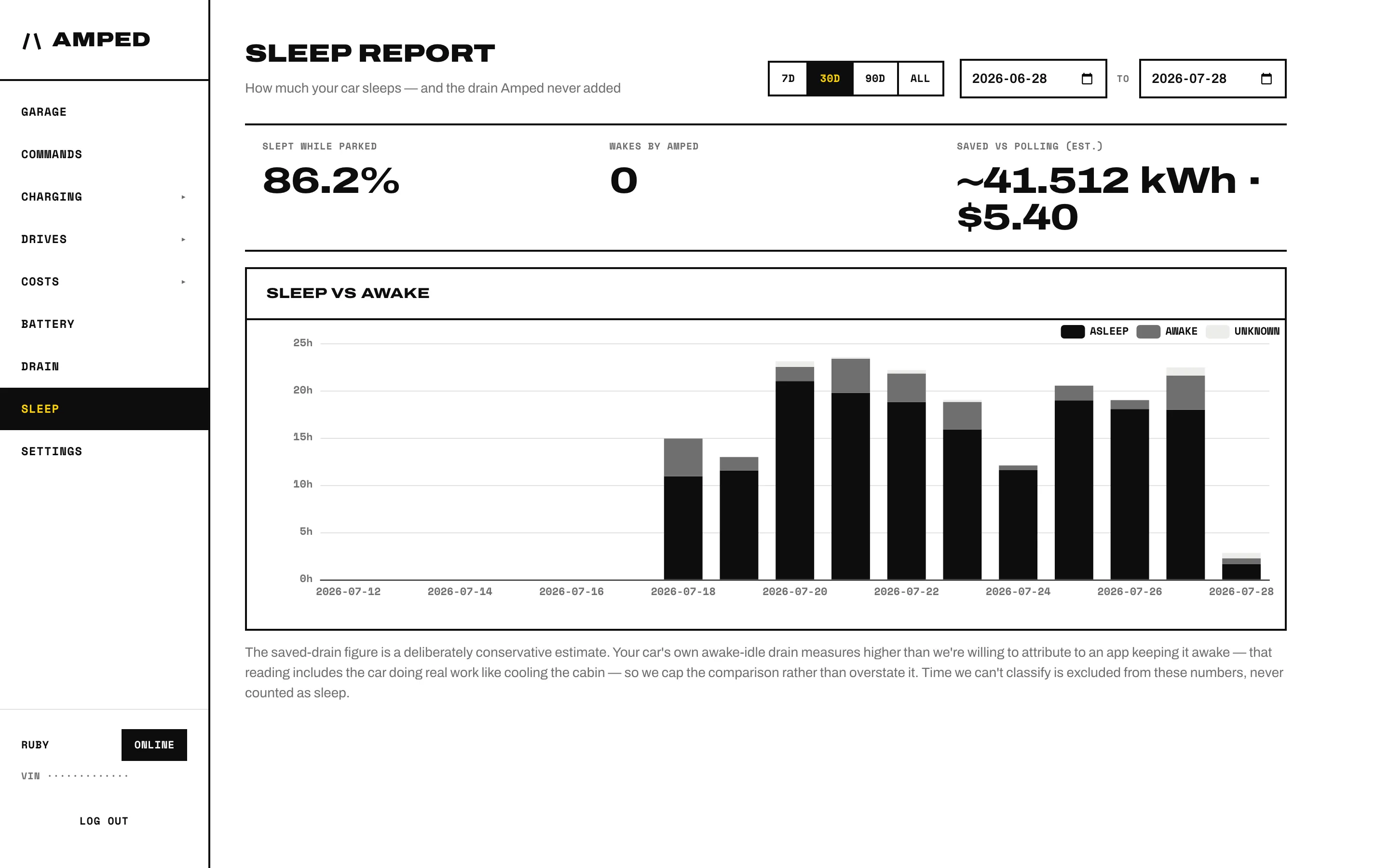
Over 30 days on one real Model 3, the car slept through 86.2% of its parked time and Amped caused zero wakes.
Zero wakes is a count, not a promise
Waking a Tesla to read from it is the expensive, battery-draining operation, and an app that checks the car on a timer has to do it again and again. Amped is telemetry-native: the car streams to us, so reads cost nothing and wake nothing. Every call we make to Tesla is written to a ledger, and the Sleep Report reads the wake count straight out of it. Over these 30 days that count was zero.
A 59.6 kWh pack, and where it came from
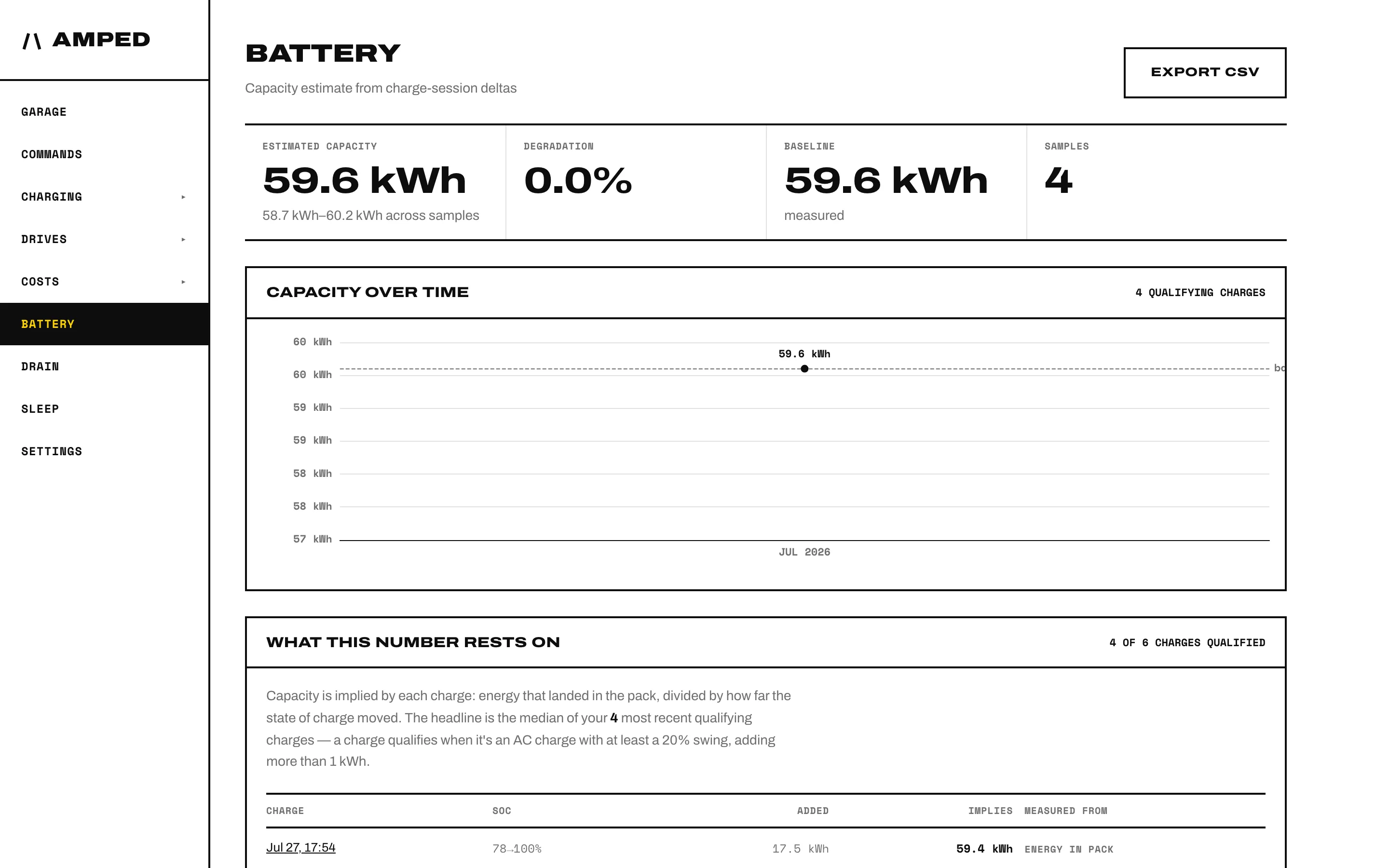
Capacity is implied by each charge: energy that actually landed in the pack, divided by how far the state of charge moved. Not wall energy — that includes charger losses and reads high. Six charges were considered, four qualified, and the four landed between 58.7 and 60.2 kWh. The screen names every one of them, and gives a reason for each charge it left out, so the number can be checked rather than believed.
86.2%, and the missing 13.8% is shown too
Of 192.5 hours parked, the car was asleep for 166.0. The rest is 23.7 hours awake-idle and 2.8 hours we couldn't classify — and unclassified time is never counted as sleep, which is why the number isn't higher. A car wakes up on its own for plenty of reasons that have nothing to do with an app; the honest figure includes all of them.
The savings figure is capped on purpose
Comparing against an app that checks the car on a timer means estimating drain that didn't happen, so the estimate is built only from this car's own data — and then deliberately held down. The car's measured awake-idle drain runs higher than we're willing to attribute to an app, because that reading includes real work like cooling the cabin. So we cap it. The number can only ever come out smaller than the truth, never larger.
What this page doesn't do
This is one car over 30 days, measured on 28 July 2026. It isn't a fleet average, a benchmark, or a promise about your car — your driving, climate and parking habits will produce different numbers. It shows that Amped does what we say, on real hardware, with the workings shown.
FAQ
Are these real numbers?
Yes. Every figure was read from the live API on 28 July 2026, for the 30 days to that date, on the founder's own Tesla Model 3 — the screenshots are that account's actual screens, unretouched apart from masking the car's VIN.
Why is it 86.2% and not higher?
Because time we can't classify is excluded from sleep rather than assumed to be sleep, and because a Tesla wakes itself for reasons no app controls. A higher figure would mean a more flattering denominator, not a better-behaved app.
How can Amped be live without waking the car?
The car streams telemetry to us over Tesla's Fleet Telemetry, rather than us asking the car for its state on a timer. A stream the car initiates doesn't wake anything; a read on a schedule does. That's the whole difference, and the zero in the wake column is what it looks like.
What does "drain not added" mean?
It estimates the battery drain an app that polls the car would have caused over the same period and that Amped did not. It is built only from this car's own asleep-versus-awake drain rates, and then capped below what the data would support, so it understates rather than overstates.
Will my car show the same numbers?
Almost certainly not exactly. Sleep percentage depends on how you park, drive and precondition; pack capacity depends on your car and its age. What carries over is the method: your figures are computed from your own history, with the arithmetic shown.